
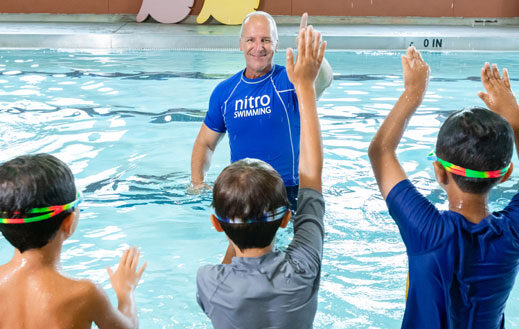
 Parents have a lot of choices when deciding what activity to introduce to their child first. Soccer. Gymnastics. Dance. T-ball. Martial arts. The list keeps growing.
I’d actually take the question one step further. Instead of asking what your child’s first sport should be, ask what you want their first activity to give them. After decades of teaching and coaching swimmers, I believe swimming is pretty hard to beat.
It develops coordination and fitness. Kids learn independence, persistence, and confidence. And unlike most childhood activities, learning to swim gives them skills that can also help protect them around water. That’s a pretty remarkable combination.
Swimming Teaches the Whole Body to Work Together
Learning to swim asks a lot of a young child’s body. Arms and legs have to work together. Kids learn to kick, reach, balance, float, rotate, and change direction. Then we add breathing to the equation.
What looks like a simple trip across the pool is actually a child learning to coordinate multiple movements at the same time.
For young swimmers, those skills develop gradually.
One week it might be getting comfortable floating. Another week it’s coordinating a kick with the right body position. Eventually, movements that once required a lot of concentration start becoming natural.
As a coach, that’s one of the things I enjoy watching most. You can actually see kids figuring out what their bodies are capable of doing.
There May Be Developmental Benefits Beyond the Pool
Swimming is obviously a physical activity, but researchers have also explored whether early swimming participation is associated with broader childhood development. Some research involving young swimmers has found associations between participation in swimming and earlier achievement of certain physical, language, cognitive, and social developmental milestones.
I think we need to be careful about what that means. Swimming shouldn’t be sold to parents as a shortcut to making a child smarter, and research showing an association doesn’t prove that swimming alone caused those developmental differences.
What I do know from years of working with young swimmers is that a swim lesson asks children to listen, follow instructions, remember sequences, coordinate movement, respond to feedback, and keep working on something until they understand it. That’s a lot of learning packed into time in the pool.
Strength and Fitness Without Kids Thinking About “Exercise”
Kids don’t need a lecture about cardiovascular fitness. They need to move.
Swimming gets the whole body involved. Children are kicking, pulling, stabilizing their bodies, and moving against the resistance of the water. As their skills develop, they also build the endurance to swim farther and for longer periods.
The nice part is that, especially for younger swimmers, none of this feels like a workout program. They’re learning to swim, and the fitness comes with it.
There’s a Special Kind of Independence That Happens in Water
One of the most rewarding moments in swim lessons happens when a child realizes they can do something without the instructor doing it for them.
Maybe it’s floating independently for the first time. Maybe it’s getting themselves back to the wall. Maybe it’s swimming a distance they couldn’t manage a few weeks earlier.
There’s a visible change when kids realize, “I did that.”
The instructor is still there. The Deck Coach is still watching. The environment is structured and supervised. But the accomplishment belongs to the swimmer. That growing independence is one of the reasons I think swimming is such a valuable activity for kids.
Swimming Gives Kids Plenty of Chances to Practice Resilience
Swimming doesn’t always cooperate. A child tries a skill and doesn’t get it. They try again. Maybe they get a little closer. Their instructor makes an adjustment. They try again.
Then one day they get it.I don’t think we need to promise parents that swimming somehow creates “grit” or guarantees future success. What swimming does provide is repeated, very real practice at dealing with something that doesn’t come easily the first time.
Kids learn that struggling with a skill isn’t the same thing as failing at it. They learn to reset, listen, make an adjustment, and try again. Those are useful lessons well beyond the pool.
Confidence Is Earned One Skill at a Time
Parents sometimes tell us they want swim lessons because their child is nervous around water. That’s understandable. Water is an unfamiliar environment, and confidence shouldn’t be forced.
At Nitro, we want children to build confidence by actually becoming more capable. A swimmer learns how to control their breathing. Then float. Then recover. Then move through the water. Something that once felt uncertain starts making sense.
That is real confidence.
It isn’t someone repeatedly telling a child, “You’re a great swimmer.” It’s the child discovering, through experience, “I know what to do here.”
I’ve watched that transformation happen countless times, and it never gets old.
And Then There’s the Reason Swimming Is Different From Every Other Sport
Swimming has another benefit that puts it in a category of its own. Learning to swim can help reduce a child’s risk of drowning.
According to the Centers for Disease Control and Prevention, drowning is the leading cause of death for children ages 1 through 4 in the United States, and formal swimming lessons can reduce drowning risk among children.
That does not mean a child who takes swim lessons is “drown-proof.” No child is. The American Academy of Pediatrics considers swimming ability one layer of water safety. Active adult supervision, appropriate barriers around pools, life jackets when needed, and other water-safety practices remain essential even for strong swimmers.
I think that’s an important distinction for every swim school to make. We don’t teach swimming so parents can worry less about supervising their children around water. We teach children to become more capable in the water while parents continue doing their part to keep them safe around it.
So, What’s the Best First Sport for a Child?
There isn’t one answer that’s right for every child.
But if you’re looking for an activity that develops coordination, fitness, independence, persistence, and genuine confidence, swimming checks an awful lot of boxes. Then add something most sports simply can’t offer, skills that may someday help a child protect themselves in the water.
That’s why, after all these years, swimming would still be my choice.
And here’s the part that might surprise you coming from the co-founder of Nitro Swimming: if not with Nitro, get swimming somewhere.
Find a quality program. Ask questions. Make sure the instructors are well trained. Look at the pool environment. Understand how the program approaches water safety and skill progression.
Then get your child in the water. Learning to swim is simply too important a skill to skip.
Mike Koleber
Co-Founder and Head Coach
Nitro Swimming
